
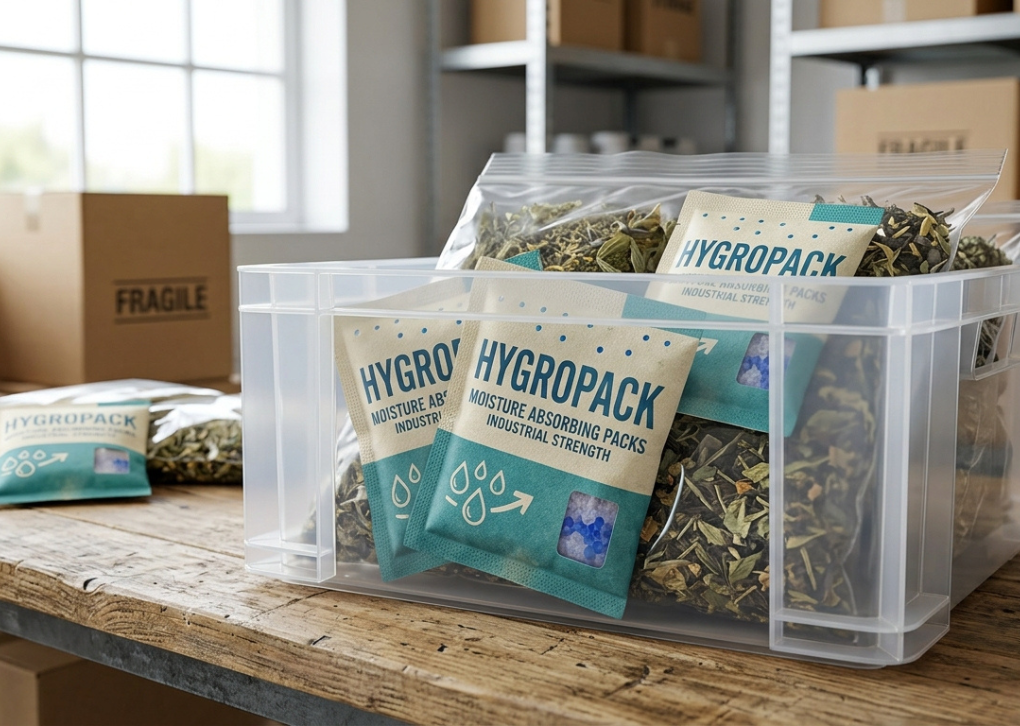
Hygropack is increasingly used online as a shorthand for packaging systems that manage moisture inside a sealed pack, bottle, pouch, barrier bag, carton, or shipping enclosure. The basic goal is simple: keep humidity within a range that protects the product from caking, corrosion, mold, loss of potency, texture changes, condensation, or other moisture-driven damage.
For buyers, one terminology issue matters: Hygropack is used inconsistently online. Packaging-focused pages use the term for desiccant and humidity-control systems, while Nather product literature uses the same wording for certain Alizé ventilation outlets. This guide focuses on the moisture-control packaging meaning that dominates current English-language search intent.
What Is Hygropack?
In practical packaging terms, the concept combines one or more moisture-control components with a sufficiently protective enclosure. A typical system may include a desiccant sachet, moisture-barrier film, humidity indicator card, sealed container, liner, cartridge, or a combination of those elements.
That distinction matters. A desiccant alone does not guarantee protection if the pouch allows water vapor to permeate rapidly, the seal is weak, the pack contains excessive initial moisture, or the product itself releases moisture during storage.
Effective moisture protection is a system-level engineering problem.
The Core Idea: Control the Package Microclimate
Every closed package contains a small internal environment, often described as the package headspace or microclimate. Water vapor can come from trapped air, the product itself, paperboard, wooden components, cushioning materials, or gradual permeation through the packaging wall.
The system works by managing that internal moisture load. Depending on the application, the objective may be to keep relative humidity low, prevent condensation, slow hydrolytic degradation, reduce corrosion risk, preserve crispness, or maintain a validated stability profile.
How Does Hygropack Work?
Most dry-pack technologies rely heavily on adsorption, not ordinary absorption. Silica gel, bentonite clay, and molecular sieves attract and hold water molecules within their porous structures, while materials such as calcium chloride can take up moisture and eventually form a liquid brine.
Once a desiccant is sealed inside a package, it starts removing water vapor from the available headspace. As humidity decreases, additional moisture may migrate out of the product or surrounding packaging materials until the system moves toward equilibrium.
The protective enclosure has another critical job: slowing the rate at which outside moisture gets back in.
ASTM F1249 is a recognized test method for determining the water vapor transmission rate (WVTR) of flexible barrier materials. ASTM specifically notes that WVTR is an important packaging property that can relate directly to packaged-product stability and shelf life.
Why Barrier Performance Matters as Much as the Desiccant
Imagine placing a powerful desiccant inside a highly permeable plastic bag. It may dry the initial headspace quickly, but it will then be forced to capture a continuing stream of water vapor entering through the package.
That is why a properly engineered moisture-control system balances desiccant capacity, package surface area, WVTR, seal quality, storage humidity, temperature, and required shelf life. Adding more desiccant is not always the smartest answer; improving the barrier can reduce the moisture load before the desiccant ever has to deal with it.
Hygropack Desiccant Types: Which Material Fits the Job?
The correct desiccant chemistry depends on the required humidity profile, temperature range, product sensitivity, regulatory environment, and economics. There is no universal “best” moisture absorber for every package.
Bentonite clay is a naturally occurring mineral frequently used for broad and economical moisture adsorption. It is useful in many general packaging environments and can retain meaningful adsorption capacity across a range of humidity conditions.
Silica gel is clean, widely used, and well suited to many consumer, industrial, food, electronic, and pharmaceutical packaging applications. Its adsorption capacity generally increases as surrounding relative humidity rises.
Molecular sieve has a particularly strong affinity for water at low relative humidity. That characteristic makes it valuable where an exceptionally dry package environment needs to be established or maintained.
Calcium chloride is often associated with larger cargo and container moisture-control applications because it can capture substantial quantities of water. Since it can deliquesce and produce liquid brine, however, the surrounding packet or collector must be designed to contain that liquid safely.
Current Clariant technical literature makes a similar distinction among bentonite clay, silica gel, and molecular sieve, describing molecular sieve as especially aggressive at low relative humidity while silica gel adsorption capacity increases with humidity.
Where Moisture-Control Packaging Adds the Most Value
Moisture protection provides the greatest commercial value when a relatively small humidity change can produce a large deterioration in quality, safety, reliability, appearance, or shelf life. That means the strongest applications are products with a known moisture sensitivity and a measurable failure mode.
- Pharmaceuticals and nutraceuticals: tablets, capsules, powders, diagnostics, supplements, and moisture-sensitive active ingredients where water exposure can alter physical or chemical stability.
- Electronics and semiconductors: moisture-sensitive devices, printed circuit assemblies, sensors, optical components, and parts vulnerable to corrosion or reflow-related failures.
- Dry foods: crackers, seasonings, powdered ingredients, dehydrated foods, snacks, and products where moisture changes crispness, flowability, water activity, or mold susceptibility.
- Industrial and metal parts: tools, bearings, precision components, automotive parts, aerospace hardware, and machinery that can corrode in humid storage or transit.
- Leather, apparel, and consumer goods: footwear, textiles, bags, and similar products vulnerable to mildew, staining, odor, or surface deterioration.
- Export and containerized cargo: shipments exposed to long transit times and temperature cycles capable of producing condensation or so-called container rain.
Moisture Control in Pharmaceutical Packaging
Pharmaceutical moisture protection should never be treated as a decorative packaging accessory. The bottle, blister, closure, seal, liner, desiccant, and drug product have to function as a complete container-closure system.
USP General Chapter <671> covers container performance testing and includes moisture vapor transmission testing for packaging systems used with oral dosage forms. USP specifically describes testing intended to assess the functional moisture-barrier properties of packaging systems.
ICH Q1A(R2), meanwhile, sets internationally recognized expectations for stability testing of new drug substances and drug products. Its framework includes controlled temperature and relative-humidity conditions, reinforcing why pharmaceutical packaging decisions should ultimately be supported by actual stability evidence.
For that reason, a pharmaceutical moisture-control design should be justified by testing rather than a generic rule such as “put one sachet in every bottle.” Desiccant mass, moisture ingress, initial product moisture, opening frequency, package dimensions, and intended shelf life can all change the required solution.
Hygropack for Electronics and Semiconductor Dry Packing
Electronics provide one of the clearest examples of properly engineered dry packaging. Industry practice for moisture-sensitive components combines a moisture-barrier bag, desiccant, and humidity indicator card, rather than expecting a desiccant packet to solve the entire problem by itself.
IPC/JEDEC J-STD-033 addresses the packaging and handling of moisture-sensitive electronic devices. Published dry-pack requirements describe systems in which desiccant and a humidity indicator card are sealed with components inside a moisture-barrier bag.
As of 2026, IPC’s revision information records J-STD-033D from May 2018, while J-STD-033E is listed under its standards-development projects rather than as a published replacement. Organizations should therefore verify the revision required by their contracts, suppliers, or internal quality systems.
The broader lesson extends beyond semiconductors. A robust dry-pack solution should often include both prevention and verification.
A humidity indicator does not remove water. It provides evidence that the internal package environment has or has not crossed a defined humidity threshold.
Hygropack for Food: Humidity Is Not the Same as Water Activity
Food packaging is one area where loose moisture terminology can create expensive mistakes. Relative humidity inside package headspace and water activity within the food are related, but they are not identical measurements.
The U.S. FDA defines water activity, or aᵥ, as the ratio between the vapor pressure of water in the food and the vapor pressure of pure water under the same conditions. At equilibrium, water activity relates to equilibrium relative humidity divided by 100.
Why does that matter?
A cracker can contain relatively little total moisture yet still change texture when moisture migrates into it. A powder may begin clumping before visible condensation is present, while other foods can experience microbiological stability changes as available water increases.
A desiccant-based package used with dry food may help maintain crispness and protect against unwanted moisture uptake. It cannot, however, compensate for poor formulation, insufficient drying, contaminated ingredients, a leaking seal, or unsuitable food-contact materials.
Food applications also require suitable food-contact compliance for packaging substances under the applicable jurisdiction and intended conditions of use. FDA guidance, for example, differentiates food-contact requirements according to food type and use conditions.
How to Size a Hygropack System Correctly
Sizing should begin with the total expected moisture load across the intended shelf life, not package volume alone. The quantity of moisture initially trapped in the headspace can be only a small part of the challenge.
A sound specification considers moisture contained in the product and internal packaging materials, vapor entering through the barrier, external relative humidity, temperature cycling, seal integrity, desiccant adsorption performance, and the highest acceptable internal humidity at end of life.
Large export packs introduce additional variables. Corrugated board, wooden pallets, blocking materials, and other hygroscopic components can carry moisture into the enclosed package before shipping even begins.
The practical takeaway is simple: do not copy a sachet size from another product merely because the package dimensions look similar. Hygropack sizing should be based on measurable environmental assumptions and barrier performance.
A Better Selection Workflow
Begin by defining the specific failure mechanism you need to prevent. Is it metal corrosion, pharmaceutical degradation, powder caking, loss of food crispness, optical fogging, mold susceptibility, or moisture absorption before semiconductor reflow?
Next, establish the maximum acceptable RH or product condition, realistic temperature range, distribution route, storage conditions, and required shelf life. Only then should you select the barrier structure, estimate moisture ingress, choose the desiccant chemistry and quantity, and validate the completed sealed package.
This reverses a common purchasing mistake. The starting question should not be “Which desiccant is cheapest?” but “What moisture condition does the product actually need?”
Hygropack vs. a Standard Silica Gel Packet
A silica gel sachet is one component. Hygropack, as the term is used throughout this guide, refers to the wider moisture-control architecture around the product.
That architecture may indeed contain silica gel. But it also asks the questions that determine whether the silica gel can succeed: How much moisture enters the package? How much is already present? What RH is acceptable? How long must protection last? Will consumers repeatedly open the pack?
This distinction is missing from much of the thin content surrounding the topic online. Calling every desiccant sachet a complete moisture-control solution overlooks barrier science, seals, distribution conditions, moisture sorption, product stability, and validation.
Common Hygropack Design Mistakes
One frequent mistake is increasing desiccant quantity while ignoring package permeability. If moisture enters faster than the overall design can manage it, the desiccant will eventually become exhausted regardless of how impressive its nominal capacity appears.
Another is assuming every desiccant behaves identically. Molecular sieve, silica gel, bentonite clay, and calcium chloride have different moisture-handling characteristics, particularly when relative humidity and temperature change.
Process control is another weak point. Desiccant starts interacting with ambient moisture as soon as it is exposed, which means packet storage, time on the filling line, resealing of bulk containers, and handling procedures affect its remaining capacity.
Seal integrity matters too. A technically excellent barrier film with a defective heat seal can perform worse than a less sophisticated material that is sealed correctly.
For high-value, safety-critical, or regulated products, verification is essential. Test the complete package configuration under realistic or appropriately accelerated environmental conditions rather than relying solely on a desiccant supplier’s headline capacity figure.
How to Evaluate a Hygropack Supplier or Packaging Specification
A credible packaging supplier should be able to discuss moisture using measurable engineering parameters rather than vague claims about “ultimate dryness.” Ask for adsorption or capacity data under relevant RH and temperature conditions, barrier-film WVTR, packet construction information, compatibility data, and applicable food, pharmaceutical, electronics, or industrial specifications.
The supplier should also be able to explain how the recommended quantity was calculated. If sizing is based solely on internal package volume and completely ignores permeability, storage duration, environmental humidity, sealing, and moisture contained in packed materials, the specification deserves closer scrutiny.
MIL-D-3464 offers a useful example of performance-based moisture-control practice. The current U.S. specification covers activated bagged desiccants intended for packaging and static dehumidification and describes their purpose as preventing corrosion and mildew by adsorbing moisture from the air within an enclosed space. The specification remained active following validation dated March 3, 2026.
That does not mean every commercial package requires a military specification. It demonstrates something more important: serious moisture management is based on defined performance criteria, not merely a packet labeled “desiccant.”
Sustainability: Use Less Material by Engineering Better
Moisture-control packaging can prevent product waste, rejected shipments, premature spoilage, corrosion, and returns. But the desiccant itself is still an additional material entering the packaging system.
So the better sustainability question is not simply, “Is this desiccant eco-friendly?”
Ask instead: Does the complete package prevent more material and product waste than it creates, and can it achieve that result with less packaging?
A better moisture barrier may allow a smaller desiccant quantity. Accurate sizing avoids unnecessarily large sachets, while improved sealing can increase protection without adding another component.
Material recovery can also become complicated when foil laminates, multilayer polymers, paper, active packaging, inks, adhesives, and desiccants are combined. Environmental claims therefore need to consider the complete packaging structure and local recycling infrastructure rather than highlighting one supposedly sustainable component.
FAQ About Hygropack
Is Hygropack the Same as Silica Gel?
No. Silica gel is one specific desiccant material, while Hygropack is better understood as a broader moisture-control packaging approach that can incorporate silica gel, bentonite clay, molecular sieve, calcium chloride, barrier films, humidity indicators, or other technologies.
The appropriate material depends on the product, acceptable humidity range, package barrier, storage conditions, and shelf-life requirement.
Can Hygropack Stop Mold Completely?
It can help reduce moisture conditions that encourage mold development, but it is not a sterilization method and should not be treated as a universal guarantee against microbial growth.
Mold risk depends on factors including initial contamination, product composition, water activity, temperature, relative humidity, storage time, and package integrity. Moisture control is one intervention within a larger product-preservation strategy.
How Long Does a Hygropack Desiccant Last?
There is no universal service life. Performance depends on desiccant chemistry and mass, initial moisture load, package WVTR, surface area, seal quality, storage temperature, external humidity, opening frequency, and the target internal relative humidity.
Two packages containing identical silica gel sachets can therefore have dramatically different useful protection periods.
Can Hygropack Be Used in Food and Medicine Packaging?
Yes. Moisture-control systems are widely used for dry foods, pharmaceuticals, nutraceuticals, diagnostics, supplements, and numerous other sensitive products.
The specific packet, container, film, ink, adhesive, closure, and other packaging components must still be suitable for the intended application. Regulated products should have appropriate compliance documentation and performance or stability evidence.
How Do I Know Whether My Product Needs Hygropack?
Start with the failure mode rather than the packaging material. If exposure to humidity can cause corrosion, caking, texture loss, chemical degradation, mildew, condensation, optical fogging, electrical reliability problems, or another measurable failure during storage and distribution, engineered moisture control may be justified.
The next step is to quantify how much humidity the product can tolerate and for how long. That information determines whether a simple desiccant packet is sufficient or whether you need a higher-barrier and fully validated packaging system.
Conclusion: Treat Hygropack as an Engineered System, Not a Sachet
The most effective Hygropack strategy begins with data. Identify the product’s moisture sensitivity, define the maximum acceptable humidity or quality threshold, calculate the expected moisture load, select an appropriate barrier and desiccant, and validate the completed packaging system under conditions that reflect real storage and distribution.
Do not begin a new packaging project by asking, “How many grams of silica gel should I use?”
Begin with the question that packaging engineers actually need answered:
“What moisture level must this product remain below, for how long, and under which distribution conditions?”
Once those parameters are defined, moisture protection stops being guesswork. It becomes measurable, testable, optimizable—and considerably more reliable.