
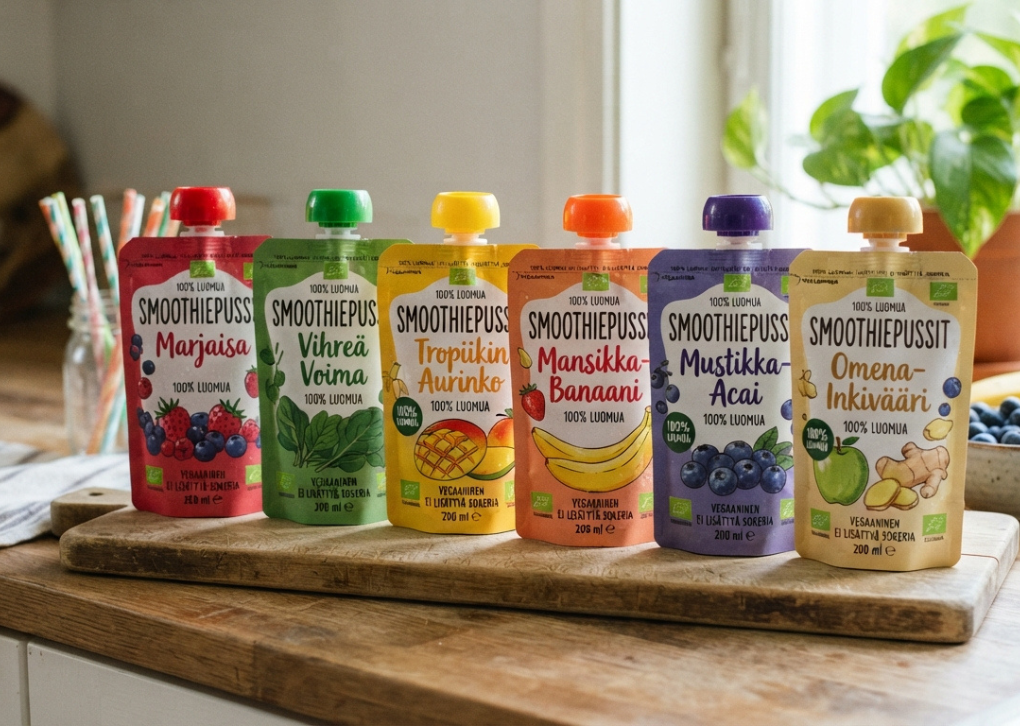
Smoothiepussit is an unusual search term, but the idea behind it is practical: make smoothies easier to prepare, portion, store, and carry. Current search results use the term for several related things, including freezer-ready smoothie ingredient bags, refillable squeeze pouches, and commercially prepared smoothie packs. The common thread is convenience.
The word itself also gives an important clue. In Finnish, pussi means a small bag or pouch, while pussit is its plural form, so “smoothie pouches” or “smoothie bags” is the clearest literal interpretation. The term is not a standardized nutrition category, however, which means the ingredients, packaging, storage method, and intended use matter far more than the label itself.
What Does Smoothiepussit Actually Mean?
The safest definition of Smoothiepussit is a pouch- or bag-based system for preparing, storing, or consuming smoothies. It can describe food that has already been blended, ingredients portioned before blending, or a retail product sold in a portable pouch.
That distinction matters because the three formats behave differently:
- Ready-to-blend packs: Fruit, vegetables, seeds, oats, or other ingredients are portioned into freezer bags and blended later with liquid.
- Reusable smoothie pouches: A prepared smoothie is poured into a washable squeeze pouch for lunches, commuting, travel, or snacks.
- Commercial smoothie pouches: A sealed product is purchased ready to consume, often with its own ingredient list, nutrition panel, storage instructions, and use-by date.
Searchers sometimes encounter articles treating the term as a brand, viral wellness trend, or completely new food. Current web usage is much broader than that. Several recent pages use it for smoothie pouches, freezer packs, or portable smoothie-preparation systems rather than one standardized product.
Why Smoothiepussit Appeal to Busy People
The attraction is not mysterious. Smoothies can be quick to drink but surprisingly time-consuming to prepare when every serving requires washing produce, peeling fruit, measuring ingredients, finding add-ins, blending, and cleaning.
Smoothiepussit shifts some of that work to an earlier moment. Instead of deciding what to make at 7:30 a.m., you can portion five packs on Sunday and blend one when needed.
That can help with:
- Meal-prep consistency
- More predictable portions
- School or office snacks
- Post-workout convenience
- Reducing overripe-fruit waste
- Using frozen produce efficiently
- Keeping ingredients varied across the week
The benefit is operational rather than magical. A pouch does not make a recipe healthier by itself; it simply makes a chosen recipe easier to repeat.
Smoothiepussit vs. a Regular Smoothie
A regular smoothie and Smoothiepussit can contain exactly the same ingredients. The real difference is workflow.
With a made-to-order smoothie, preparation and consumption happen almost at the same time. With a pouch or freezer-pack system, at least part of the work is moved earlier: ingredients may be washed and portioned in advance, or the finished drink may be stored for later.
That creates three practical differences.
1. Portioning Becomes More Predictable
When ingredients are pre-measured, you are less likely to keep adding handfuls of fruit, nut butter, sweeteners, or calorie-dense extras without noticing. A repeatable portion also makes it easier to compare recipes and adjust them over time.
This is particularly useful for people who want consistency rather than a completely different smoothie every morning.
2. Texture Needs More Planning
Frozen banana, mango, berries, avocado, oats, chia, yogurt, and leafy greens behave differently after freezing or refrigeration. A good pack therefore balances ingredients that freeze well with liquid that is added only at blending time.
Too much frozen produce with too little liquid can overwhelm a household blender. Too much liquid, on the other hand, may produce a thin mixture that leaks or is awkward to eat from a squeeze pouch.
3. Food Safety Matters More
The longer food is stored, carried, thawed, or reused in a container, the more important handling becomes. Smoothiepussit should be treated as prepared food, not as a shelf-stable item unless the manufacturer explicitly says otherwise.
That becomes especially important when recipes contain dairy products, cut fruit, cooked grains, or other perishable ingredients.
Are Smoothiepussit Healthy?
They can be, but the answer depends completely on the recipe.
A pouch built from berries, plain yogurt, oats, spinach, and a modest amount of milk is nutritionally different from one made primarily from juice, sweetened yogurt, syrup, and several servings of high-sugar fruit. The container does not determine nutritional quality.
A useful way to build a more balanced smoothie is to combine four roles:
- Fruit or vegetables for flavour, micronutrients, colour, and texture
- Protein from plain yogurt, kefir, milk, fortified soy drink, cottage cheese, or another suitable source
- Fibre and texture from oats, chia, flax, vegetables, berries, or whole fruit
- Liquid from water, milk, or an unsweetened alternative
Sweeteners should be optional, not automatic.
One important point is often missed. Health guidance may treat blended fruit differently from whole fruit because blending releases sugars from the cellular structure. The UK NHS advises limiting the combined amount of fruit juice, vegetable juice, and smoothies to 150 ml per day and recommends having them with meals to reduce the impact on teeth.
That does not mean every smoothie is “bad.” It means a giant fruit-heavy pouch should not automatically be treated as nutritionally identical to eating the same volume of intact whole fruit.
A Better Smoothiepussit Formula
For home preparation, a simple template works better than random ingredient stacking.
For one moderate serving, try:
- 100–150 g fruit or vegetables
- 80–120 g plain yogurt or another protein-rich base
- 10–25 g oats or seeds
- 100–180 ml liquid added at blending time
- Optional flavourings such as cinnamon, cocoa, ginger, vanilla, mint, or lemon zest
These amounts are a practical kitchen template rather than a medical nutrition prescription. Adjust them based on appetite, energy needs, texture preference, age, and the nutritional role of the smoothie.
Three Practical Flavour Combinations
Berry-oat: Frozen mixed berries, banana, plain yogurt, oats, and milk.
This combination offers a thick texture without needing large amounts of added sweetener. Using berries as the dominant fruit can also keep the flavour bright without relying entirely on banana.
Mango-green: Mango, spinach, plain yogurt, ginger, and water or milk.
The mango gives sweetness and body, while spinach can be incorporated without dominating the flavour if the portion remains moderate.
Cocoa-banana: Banana, plain yogurt, oats, unsweetened cocoa, and milk.
This version feels more dessert-like while still giving you control over the amount of added sugar.
These are templates rather than individualized meal plans. People with allergies, diabetes, kidney disease, swallowing difficulties, or other dietary requirements may need advice tailored to their needs.
How to Make Smoothiepussit at Home
The easiest method for many households is to prepare ready-to-blend freezer packs rather than freezing large batches of finished smoothies.
Step 1: Choose Ingredients That Freeze Well
Good options include:
- Berries
- Sliced banana
- Mango
- Pineapple
- Peaches
- Spinach
- Kale
- Oats
- Chia seeds
- Grated ginger
Avocado can also freeze reasonably well for smoothie use, although its texture changes after thawing.
Avoid filling a rigid container completely with liquid before freezing. Liquids expand as they freeze, so containers need suitable headspace and must be designed for freezer storage.
Step 2: Wash Fresh Produce Properly
Rinse fresh fruits and vegetables under running water before cutting or preparing them. The FDA advises against washing produce with soap, detergent, or commercial produce wash; firm items such as melons or cucumbers can be scrubbed with a clean produce brush.
Wash produce even when you plan to peel it. Cutting through an unwashed surface can transfer contamination from the outside onto the edible portion.
Step 3: Portion Each Bag
Measure one serving into each food-safe freezer bag or container.
Write the preparation date and flavour on the pack. If the recipe needs additional ingredients later, add a short instruction such as:
Add 150 ml milk + 100 g yogurt
That prevents forgotten recipes from becoming unidentified frozen bags a few weeks later.
Step 4: Freeze Flat
Flat packs freeze compactly, stack neatly, and are easier to organize. Spreading ingredients into a thin layer can also make frozen pieces easier to separate when you are ready to blend.
If ingredients have frozen into one hard block, avoid forcing them into a blender that cannot handle solid frozen pieces. Allow the pack to soften appropriately or follow the blender manufacturer’s instructions.
Step 5: Blend Only What You Need
Empty one pack into the blender, add the planned liquid and any refrigerated ingredients such as yogurt, then blend until smooth.
Add liquid gradually. You can always thin a smoothie, but making an overly thin mixture thick again usually requires adding more ingredients.
Step 6: Transfer Carefully
If you are using a reusable squeeze pouch, do not overfill it.
Leave enough room to close the seal without pushing smoothie into the zipper, cap, or seam. Wipe the sealing area clean before closing.
Food-Safety Rules That Matter
Smoothiepussit are convenient only when the cold chain is handled properly.
FoodSafety.gov recommends keeping refrigerators at 40°F/4°C or below and freezers at 0°F/-18°C or below. Perishable foods should generally not remain unrefrigerated for more than two hours, or more than one hour when the surrounding temperature is above 90°F/32°C.
For a lunchbox, school bag, commute, or picnic, use an insulated bag with an appropriate cold source if the smoothie contains dairy, cut fruit, or other perishable ingredients.
Do not assume that a thick texture or frozen starting point keeps a smoothie safe for an entire warm day.
Clean Reusable Pouches Thoroughly
Reusable containers require more attention than many people realize. Food-safety guidance recognizes that reusable food containers can create cross-contamination risks if they are not appropriately cleaned, sanitized, and inspected before reuse.
Practical habits include:
- Rinse the pouch shortly after use so residue does not dry inside it.
- Open all seals, caps, spouts, and folds while washing.
- Follow the manufacturer’s dishwasher or hand-washing instructions.
- Allow every component to dry completely before storage.
- Inspect seams and corners where food residue can collect.
- Replace damaged containers that become cracked, warped, difficult to seal, or impossible to clean properly.
Reusable does not mean permanent.
Refrigerated vs. Frozen Smoothiepussit
Freezing ingredient packs is often simpler for batch preparation because most ingredients remain unblended until the day of use.
Finished smoothies can also be refrigerated, but their quality changes. Separation is normal. Oats absorb liquid, chia thickens mixtures, some fruits oxidize, and leafy greens may lose their fresh colour.
If you prepare a finished smoothie ahead of time, store it in a clean, sealed container and keep it continuously cold.
FoodSafety.gov notes that frozen foods held continuously at 0°F/-18°C or below have very different storage considerations from refrigerated foods; freezer recommendations often relate to quality, while safe refrigerator storage periods can be much shorter depending on the food.
Because there is no universal storage time that applies to every homemade smoothie recipe, ingredients matter. A fruit-and-water blend, dairy-based smoothie, and mixture containing cooked grains should not automatically be assigned identical storage lives.
When in doubt, prepare smaller quantities rather than trying to maximize storage time.
How to Choose Commercial Smoothiepussit
A colourful pouch and the word “smoothie” do not tell you enough. Read the actual label.
Check the Ingredient List
Ingredients are normally presented in descending order by weight, which helps reveal what dominates the product.
A pouch whose first several ingredients are fruit concentrates or sweetened ingredients is very different from one containing whole fruit purée, vegetables, yogurt, oats, or seeds.
Look Beyond “No Added Sugar”
“No added sugar” does not mean “sugar-free.”
Fruit-based products can contain substantial naturally occurring sugars, particularly when the fruit has been puréed, juiced, concentrated, or blended.
Compare Protein and Fibre
If you want a smoothie to serve as a more substantial snack rather than simply a sweet drink, protein and fibre deserve attention.
Two products with almost identical branding can vary considerably.
Check Serving Size
A nutrition panel only becomes meaningful when you compare it with the amount you will actually consume.
A small pouch may represent one serving. A large bottle or family-size pack may contain multiple servings.
Review Allergens Carefully
Depending on the recipe, smoothie-style products may contain:
- Milk
- Tree nuts
- Peanuts
- Soy
- Oats or cereals containing gluten
- Seeds or other ingredients relevant to individual allergies
Never assume a fruit-forward package contains only fruit.
Follow Storage Instructions
Commercial products may be:
- Shelf-stable before opening
- Refrigerated
- Frozen
- Refrigerated after opening
Those categories are not interchangeable.
Follow the product label rather than applying homemade-smoothie storage assumptions to a commercially processed pouch.
Sustainability: Are Reusable Pouches Better?
Reusable Smoothiepussit can reduce the number of single-use pouches discarded, but sustainability is not determined by one packaging feature.
A reusable pouch still requires raw materials, manufacturing, transport, washing, and eventual disposal. Its environmental value improves when it is used repeatedly and actually replaces disposable packaging.
For ready-to-blend freezer packs, alternatives include:
- Reusable silicone freezer bags
- Durable food-storage containers
- Freezer-safe glass containers
- Reusable rigid plastic containers designed for freezing
Each option has trade-offs.
Glass is durable and does not retain odours easily, but it is heavier and can break. Silicone bags are flexible and compact, but some designs are harder to clean around corners and seals.
The most sustainable system is often the one you can maintain for a long time without repeatedly replacing containers.
Smoothiepussit for Reducing Food Waste
One overlooked advantage of smoothie prep is its ability to rescue produce before it becomes unusable.
Bananas that are becoming too ripe can be peeled, sliced, and frozen. Berries approaching peak ripeness can be washed, dried, and portioned. Extra spinach can be divided among several freezer packs before it wilts.
That does not mean every ageing ingredient belongs in a smoothie. Produce showing mould, decay, or signs of spoilage should be discarded rather than “saved” through freezing.
Freezing preserves food; it does not reverse spoilage.
Common Mistakes to Avoid
Most failed smoothie-prep systems do not fail because the recipes are complicated. They fail because of a few predictable mistakes.
- Using only fruit and juice: This can result in a very sweet smoothie with relatively little protein.
- Adding too much banana: Banana is useful for body, but large quantities can overpower other flavours.
- Freezing too much liquid in a rigid container: Expansion can cause leakage or container failure.
- Forgetting to label packs: Mystery freezer bags quickly become waste.
- Ignoring pouch cleaning: Residue can remain around seams, spouts, caps, and closures.
- Leaving prepared smoothies warm for hours: Cold food still requires appropriate cold storage.
- Assuming homemade means nutritionally balanced: Ingredients and portions still matter.
- Making 30 packs before testing a recipe: A flavour you dislike becomes an expensive freezer problem.
- Treating every pouch as equivalent: A baby-food pouch, freezer ingredient pack, and sports smoothie can serve completely different purposes.
Start with small batches and improve the system from experience.
Who Can Benefit Most?
Smoothiepussit is particularly useful for people who already enjoy smoothies but dislike the daily preparation.
Busy parents may use freezer packs to shorten breakfast preparation. Students and office workers may appreciate portable options when cups, bowls, and utensils are inconvenient.
People who exercise may pre-portion ingredients so a post-training smoothie is easier to prepare without measuring everything while tired or hungry.
The approach can also help households reduce produce waste by freezing suitable ingredients before they spoil.
It may be less useful if you dislike blended foods, require highly individualized medical nutrition, do not have reliable refrigeration while transporting prepared food, or prefer whole fruit and solid meals.
Frequently Asked Questions About Smoothiepussit
Is Smoothiepussit a Real Finnish Word?
The linguistic components are clear. Finnish pussi means a small bag or pouch, while pussit is its nominative plural form.
Online use of the complete expression is less standardized, so it is more accurate to understand it descriptively as “smoothie bags” or “smoothie pouches” rather than claiming it is an official nutrition or food-industry classification.
Can I Freeze a Smoothie Directly in a Reusable Pouch?
Only if the manufacturer states that the pouch is freezer-safe.
Leave enough room for expansion and make sure the closure is appropriate for freezing. For many households, freezing the solid ingredients and blending the smoothie shortly before consumption gives better texture and simplifies cleaning.
How Long Can a Smoothie Stay Out of the Refrigerator?
For a perishable smoothie, standard food-safety rules should apply.
FoodSafety.gov recommends refrigerating perishable foods within two hours, or within one hour when temperatures exceed 90°F/32°C.
A smoothie carried for several hours should therefore be kept appropriately cold rather than simply placed in a normal handbag or backpack.
Are Smoothie Pouches Good for Children?
They can be convenient, but suitability depends on the child’s age, ingredients, serving size, allergy risks, feeding abilities, and the manufacturer’s instructions.
Parents should also consider how often children sip fruit-heavy smoothies. The NHS recommends limiting fruit juice and smoothies to a combined 150 ml per day and having them with meals because blending releases sugars that can contribute to tooth decay.
What Is the Best Way to Start Using Smoothiepussit?
Start with three freezer packs rather than preparing an entire month’s supply.
Use a simple formula: fruit or vegetables + protein source + fibre-rich ingredient + liquid added when blending. Test the portion, flavour, and texture before scaling your preparation to a full week.
Conclusion: Make Convenience Work for You
Smoothiepussit is best understood not as a miracle health product but as a practical smoothie-preparation system. Its real value comes from moving decisions, measuring, and ingredient preparation out of rushed moments and into a controlled meal-prep routine.
Start small. Choose two or three balanced recipes, portion them into clearly labelled freezer packs, follow safe food-handling practices, and choose reusable containers only when they can be cleaned thoroughly and fit your routine.
Used properly, Smoothiepussit becomes less about trendy packaging and more about creating a repeatable system. That is where the real advantage lies: less preparation friction, better portion consistency, less avoidable food waste, and an easier way to keep smoothies available when you actually want them.
[…] LessInvest.com crypto has gained attention among people looking for cryptocurrency information, investment guidance, and digital asset education. However, before assuming it is a crypto exchange or […]
[…] mainly on educational content covering topics such as stocks, real estate, cryptocurrencies, ETFs, retirement planning, and investment strategies. […]
[…] the time of research, publicly available information about Metroworlds.com itself is limited, making it important to approach the platform with careful evaluation rather than assumptions. […]