
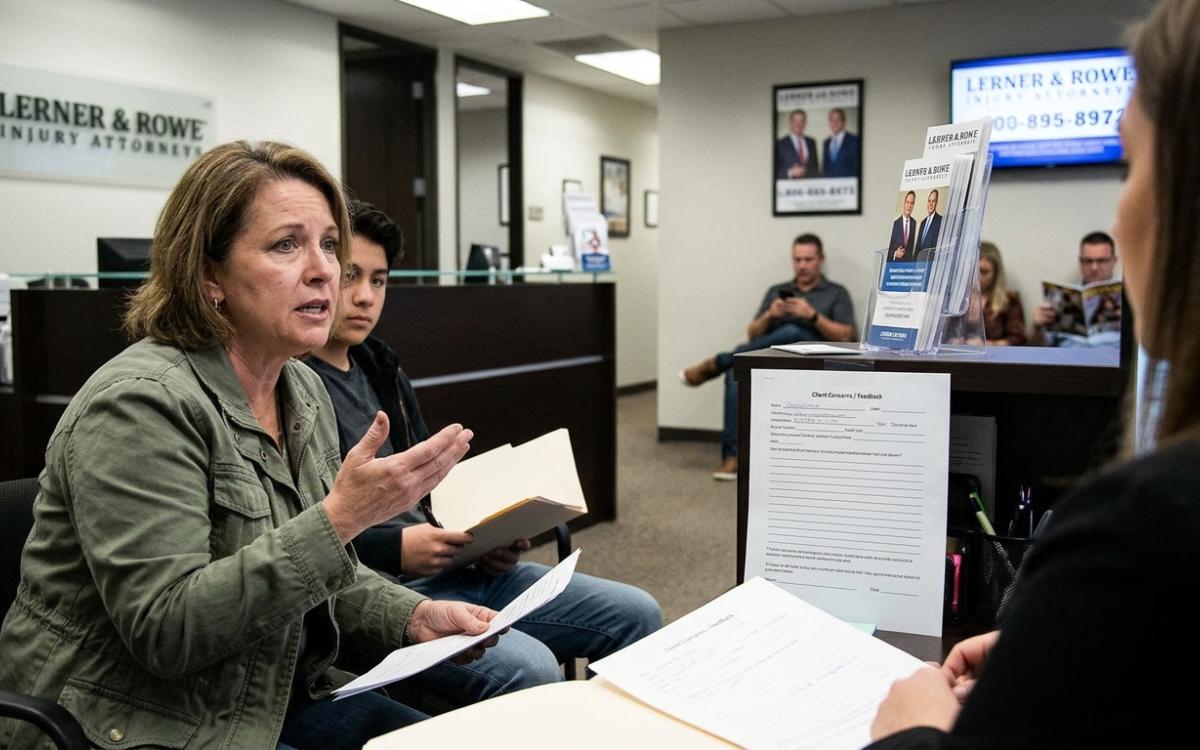
People searching for Lerner and Rowe complaints are usually trying to answer a practical question: “Should I trust this law firm with my injury claim?” The public record gives a more useful answer than either glowing advertising or a handful of angry reviews because it shows both recurring consumer concerns and the firm’s responses.
As of August 19, 2026, the Better Business Bureau profile for Lerner and Rowe Injury Attorneys in Arizona reports five complaints over the previous three years, with all five listed as answered. BBB categorizes those complaints as two billing issues, two service-or-repair issues, and one sales-and-advertising issue; the same profile currently carries an A BBB rating.
That combination matters. Lerner and Rowe complaints should be read as due-diligence signals, not automatic proof of malpractice, dishonesty, or an unethical practice. BBB itself warns that it does not verify the accuracy of third-party complaint statements and advises consumers to consider the nature of complaints, company size, and business responses rather than looking only at a raw count.
Quick Takeaways From Lerner and Rowe Complaints
- Communication is the clearest recurring concern: some reviewers describe delayed updates, difficulty reaching case staff, or inconsistent answers.
- Medical bills and liens create confusion: several complaints involve unpaid or disputed medical balances, collection notices, lien questions, or uncertainty about what was deducted from a settlement.
- Net settlement disappointment appears repeatedly: some reviewers focus less on the gross settlement and more on how much remained after attorney fees, medical charges, and other deductions.
- The firm disputes key allegations: public BBB responses describe work performed, policy-limit problems, medical-bill reductions, contact attempts, and settlement progress.
- A complaint is not a disciplinary finding: consumers should separately check the licensing and public discipline record of the specific lawyer handling their matter.
What Lerner and Rowe Complaints Actually Show
The most useful way to analyze Lerner and Rowe complaints is by theme rather than by star rating. A one-star review can reflect a serious service problem, unrealistic expectations, a difficult insurance claim, or a mixture of all three, so the underlying facts matter more than the score.
BBB’s Arizona complaint page shows five complaints in its current three-year reporting window. Two are classified as billing issues, two as service or repair issues, and one as a sales-and-advertising issue, and each is marked “Answered.”
1. Communication and Case-Status Frustration
Communication is one of the most consistent themes in Lerner and Rowe complaints and reviews. A 2024 BBB complainant alleged long delays, changing attorneys and assistants, inconsistent information, and difficulty getting clear answers; a July 2026 BBB reviewer similarly said repeated requests for a timeline produced limited clarity about missing medical bills and settlement accounting.
This issue is significant because client communication is not merely a customer-service preference. The State Bar of Arizona says reasonable lawyer-client communication is necessary for clients to participate effectively in representation, and its ER 1.4 guidance notes that failures of diligence and communication are among the most common client complaints about lawyers.
The same guidance adds an important nuance: lawyers may delegate some routine communication to staff, but the lawyer remains responsible for keeping the client adequately informed. That makes a useful evaluation question simple: Are you getting enough accurate information to make informed decisions about treatment, settlement, litigation, and expenses?
2. Medical Bills, Liens, and Collection Problems
Another recurring cluster within Lerner and Rowe complaints involves medical bills after an accident claim. In BBB material, complainants have alleged that medical balances remained unresolved or later appeared in collections, while the firm responded in at least one case that it had paid or reduced known bills and had not received documentation for another provider’s invoice.
These disputes can become confusing because a personal injury settlement is not necessarily the same thing as the client’s take-home amount. Medical liens, outstanding provider balances, case expenses, attorney fees, and other valid deductions can affect how much remains for the injured client.
The firm’s own fee page says it works on a contingency-fee basis and highlights medical-care coordination and resolving or avoiding medical liens as part of its service. That makes it reasonable for a client to ask for a written, line-by-line explanation of every known lien, bill, fee, cost, reduction, and unresolved balance before signing a final disbursement statement.
3. Dissatisfaction With the Net Settlement
Some Lerner and Rowe complaints focus on the gap between the available insurance coverage or gross recovery and the amount the client ultimately received. That frustration can be genuine without proving that the lawyer mishandled the case because policy limits, liability disputes, medical charges, case costs, and the available evidence may all affect a recovery.
A 2024 BBB review, for example, expressed disappointment that medical providers and legal fees consumed a large share of the recovery. In a separate BBB complaint response, the firm said a client had more than $85,000 in medical expenses but only $30,000 in recoverable insurance coverage, and that the firm had substantially reduced medical bills before distribution.
The practical lesson is to request a settlement waterfall before accepting an offer. Ask for the gross settlement, attorney percentage, case expenses, every medical lien or balance, expected reductions, any applicable reimbursement claim, and the estimated net amount payable to you.
4. Delays: When Is a Long Case Actually a Problem?
Delay appears in several Lerner and Rowe complaints, but elapsed time alone does not establish neglect. Personal injury claims can slow down because treatment is continuing, records are incomplete, insurers dispute liability, multiple claimants are pursuing limited coverage, liens remain unresolved, or litigation becomes necessary.
In one 2024 BBB response, Lerner and Rowe stated that many cases take approximately nine to eighteen months and described work involving underinsured-motorist coverage and medical-bill reductions. That was the firm’s explanation in a specific public complaint response, not a guaranteed or universal timetable for personal injury cases.
A better test is whether the timeline is explainable. If the team can identify what has been completed, what remains outstanding, who currently has the next action, and the next expected milestone, a slow case may still be progressing; repeated vague answers without a documented next step deserve closer scrutiny.
5. Attorney Liens After a Client Changes Firms
One of the more legally significant Lerner and Rowe complaints involved a former client who objected to a lien after terminating representation. Lerner and Rowe responded that it filed an attorney lien because it believed a considerable amount of work had already been performed on the case.
This is exactly the kind of issue consumers should clarify before switching lawyers. If you are considering termination, request your signed fee agreement, case-cost ledger, current demand or settlement status, complete client file, and a written explanation of any fee or lien the firm believes it may claim.
Do not assume that terminating a contingency-fee lawyer automatically resolves every fee question, and do not assume a claimed lien is automatically valid either. Contract terms and applicable law differ by jurisdiction, so an independent local attorney can review the agreement when the amount or consequences are significant.
Are Lerner and Rowe Complaints Evidence of Legal Malpractice?
No. Lerner and Rowe complaints appearing on BBB or other review platforms are allegations and personal accounts, not court findings or bar-discipline determinations. BBB expressly states that it does not verify the accuracy of information submitted by third parties.
Whether conduct rises to the level of legal malpractice requires a separate, jurisdiction-specific legal analysis. A disappointing result, unpleasant interaction, or negative review can justify further investigation without independently establishing professional negligence.
Attorney discipline is also a separate process. The State Bar of Arizona investigates alleged violations of professional-conduct rules and may dismiss a complaint, offer remedial diversion, or move the matter into further investigation depending on the evidence and nature of the allegations.
How the Firm Responds to Complaints
A fair review of Lerner and Rowe complaints should include the firm’s side. Its published BBB responses have disputed accusations that no work was performed, described attempts to contact clients, cited policy-limit demands and settlements, explained missing medical invoices, and pointed to reductions negotiated with medical providers.
That does not prove every complaint is unfounded. It shows why readers should look for documentary evidence—emails, demand letters, settlement statements, medical ledgers, insurer correspondence, call records, and signed fee agreements—rather than treating either the complaint or the firm’s response as automatically correct.
The firm also states publicly that its injury representation operates on a contingency-fee model and that payment terms are reviewed before the client hires the firm. Arizona ER 1.5 independently requires written fee terms and says a contingent-fee agreement must explain how the fee is calculated, relevant percentages, expenses that may be deducted, and how the client’s recovery is determined.
What to Do If You Have a Problem With Lerner and Rowe
If you are reading Lerner and Rowe complaints because you already have an active case, start with documentation rather than confrontation. Send a concise written request asking for your current case status, outstanding tasks, next deadline or milestone, any existing settlement offer, known medical liens, itemized expenses, and the name of the lawyer currently responsible for the matter.
If the concern involves a settlement distribution, request a written accounting before signing. Arizona’s contingent-fee rule states that when a contingent-fee matter concludes, the lawyer must provide a written statement showing the outcome and, if money was recovered, the remittance to the client and the method used to determine it.
If the issue remains unresolved, the correct next route depends on the type of dispute. A BBB complaint may address consumer-service concerns, while a state bar charge is designed for alleged professional misconduct; in Arizona, the State Bar says complaints typically begin through its Intake Department, which evaluates the allegation and supporting information.
Fee disputes may have a separate process. In Nevada, for example, the State Bar provides a free Fee Dispute Arbitration Program for attorney-client fee disputes of $250 or more when attempts to resolve the disagreement have failed.
How to Evaluate Lerner and Rowe Complaints Before Hiring the Firm
Prospective clients should use Lerner and Rowe complaints as interview material. Instead of asking, “Do you have bad reviews?” ask questions tied to the patterns found in public complaints: “Who gives me case updates?”, “How quickly are calls normally returned?”, “Who tracks medical balances?”, “When will I see a net-settlement estimate?”, and “What happens if I decide to change lawyers?”
Also verify the individual attorney, not only the law-firm brand. The State Bar of Arizona explains that public disciplinary history can be searched by attorney name and that records involving sanctions remain public, while certain dismissed charges are available only for a limited period and diversion records are confidential.
This distinction prevents a common research mistake. A law firm can have many clients, multiple offices, positive reviews, negative reviews, and lawyers with different professional histories; those separate signals should not be collapsed into a single yes-or-no verdict.
For anyone researching Lerner and Rowe complaints before a consultation, the most valuable next move is to verify who would actually handle the claim and establish communication, fee, medical-bill, and settlement-accounting expectations before signing.
A Better Framework for Reading Online Legal Reviews
The biggest information gain from Lerner and Rowe complaints comes from separating four questions: Was communication adequate? Was the financial accounting understandable? Was the legal strategy reasonably explained based on the information available? And is there objective evidence of professional misconduct?
Reviews are strongest as due-diligence evidence when they contain dates, specific communications, identifiable milestones, documents, and a clear description of what happened. They are less useful when they treat a low settlement as automatic proof of wrongdoing, omit important financial context, or make sweeping claims that cannot be independently verified.
Positive reviews deserve the same scrutiny. The Arizona BBB review page contains both favorable and critical customer accounts, illustrating why no individual review can predict the value, speed, service quality, or outcome of another client’s case.
FAQs About Lerner and Rowe Complaints
What are the most common Lerner and Rowe complaints?
The recurring themes in the current Arizona BBB material include communication delays, uncertainty about case progress, medical-bill or lien disputes, dissatisfaction with settlement distributions, and responsiveness concerns involving attorneys or case staff. BBB currently categorizes the five complaints on its Arizona profile as two billing issues, two service-or-repair issues, and one sales-and-advertising issue.
Those themes should still be treated as allegations and consumer experiences rather than established misconduct. In several cases, the firm provided detailed responses disputing or contextualizing the complainant’s version of events.
Does Lerner and Rowe have a lot of BBB complaints?
The Arizona BBB profile currently reports five complaints during the last three years, with one complaint closed during the previous twelve months. BBB also lists the business as accredited with an A rating on that profile.
The raw number should not be interpreted without context. BBB specifically advises consumers to consider a company’s size, the substance of each complaint, and how the company responds rather than judging solely from complaint volume.
Are negative Lerner and Rowe reviews proof the firm committed malpractice?
No. Negative reviews and Lerner and Rowe complaints are consumer allegations, while malpractice and attorney discipline require separate legal or regulatory analysis.
A poor experience, delayed response, billing disagreement, or disappointing recovery can provide a reason to request records or seek a second opinion without proving a violation. If misconduct is suspected, the professional regulator for the relevant jurisdiction is a more appropriate source than a consumer-review platform.
What should I ask for if I am unhappy with my settlement?
Request the gross settlement amount, contingency-fee percentage, case expenses, every medical lien and provider balance, negotiated reductions, applicable reimbursement obligations, and your estimated net recovery. Ask what remains unresolved and whether additional bills could surface after disbursement.
If something is unclear, request the explanation in writing before signing the settlement accounting or disbursement paperwork. Arizona ER 1.5 contains specific written-disclosure requirements for contingent fees and final recovery statements.
Where can I file a formal complaint about a Lerner and Rowe lawyer?
Use the professional regulator for the jurisdiction where the attorney is licensed or where the representation occurred. In Arizona, the State Bar’s Intake Department handles charges alleging professional misconduct and can gather information, contact the lawyer, and determine whether dismissal, diversion, or further investigation is appropriate.
Consumers can also search public discipline histories through the State Bar of Arizona. Nevada likewise operates an attorney-discipline system, while its separate fee-dispute program may be more appropriate when the disagreement concerns attorney fees rather than professional misconduct.
Conclusion: Use Complaints as Evidence, Not a Verdict
The smartest way to interpret Lerner and Rowe complaints is neither to dismiss them nor to treat them as conclusive. Public BBB records reveal recurring friction involving communication, medical-bill handling, settlement accounting, and case timing, but they also contain detailed firm responses and do not themselves establish malpractice or ethical violations.
If you are considering hiring the firm, turn those complaint themes into specific questions before signing a contingency agreement. Find out who will manage the case, how updates work, what the fee agreement covers, how medical liens will be tracked, and when you will receive an estimated net-settlement calculation.
If you are already a client, request a written status report and complete financial accounting. If the problem remains unresolved, choose the remedy that actually matches the dispute: an internal escalation for service issues, a fee-dispute process for qualifying fee disagreements, an independent lawyer for a second opinion, or the appropriate state bar when you believe professional rules may have been violated.
Editorial note: This article summarizes publicly available information reviewed on August 19, 2026. It is general consumer information, not legal advice, and allegations appearing in public reviews or complaints should not be treated as proven facts.