
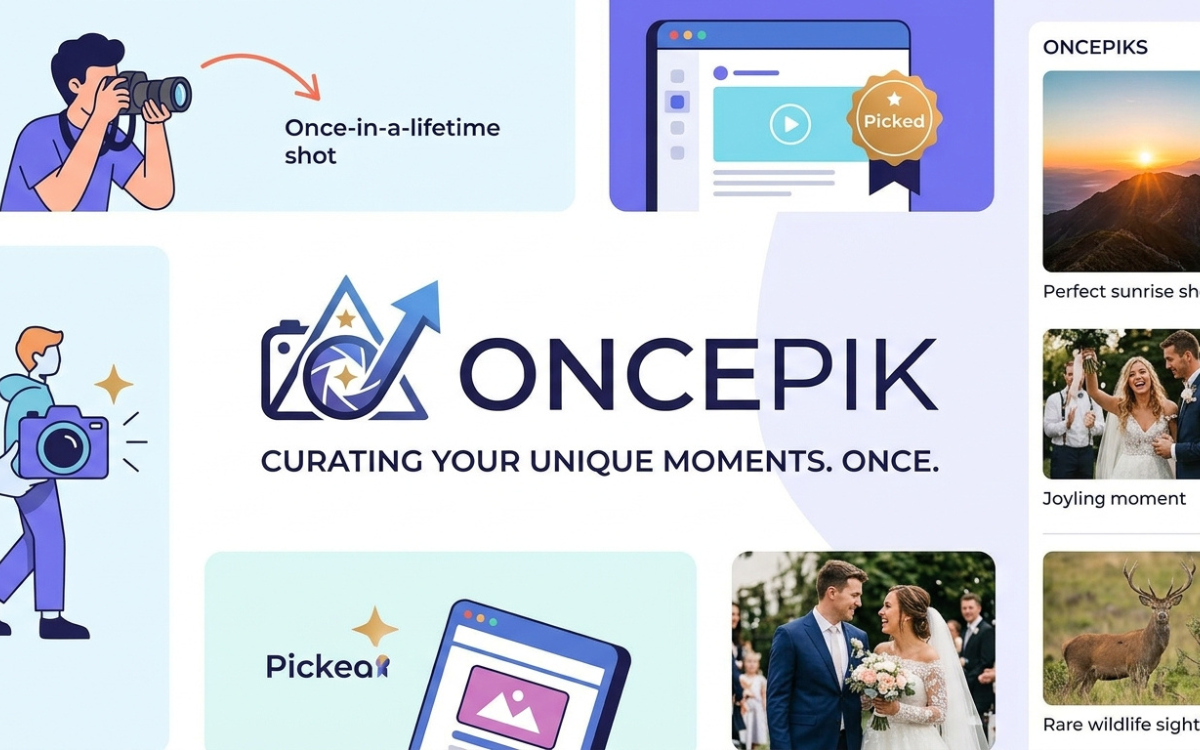
Oncepik is a search term with an unusual problem: the web talks about it as though it were one established product, but current evidence points to several different identities. Some pages describe a visual productivity platform, while active websites using the name focus on photography, technology news, fashion, and SEO services. That makes careful verification more useful than another recycled feature list.
What Is Oncepik?
The most accurate answer is that Oncepik is an ambiguous digital brand term rather than one clearly documented, universally identifiable platform. Across search results, it is commonly described as a visual-first workspace for organizing projects, creative assets, tasks, content, and team collaboration. Yet those descriptions are not consistently tied to a single official software website, pricing page, app listing, documentation hub, or publicly identified operator.
At the same time, active domains using nearly the same name have distinct editorial or commercial purposes. The “oncepiks.com” site presents itself as a photography learning platform, the “.net” site describes itself as a technology-news publication, the “.org” site currently publishes fashion content, and the “.co.uk” site promotes SEO services.
That distinction matters. A reader searching the keyword may be looking for a software tool, a photography resource, or simply an explanation of a name appearing across multiple sites.
Why the Oncepik Search Results Are So Confusing
A large cluster of third-party articles repeats a similar description: visual boards, collaboration, task management, media organization, AI assistance, and flexible workspaces. Some even compare the concept with Trello, Notion, Miro, ClickUp, or Milanote.
The problem is not that these features are impossible. They are plausible features for modern collaboration software. The problem is evidence. Repetition across unrelated blogs does not prove that a live product currently offers every claimed capability.
An especially important clue is the exact-match “.com” domain. Recent domain-market data has shown it listed for sale rather than operating as a clearly identifiable SaaS homepage.
Oncepik at a Glance: What Is Verified and What Is Not?
| Area | What can be verified | What remains uncertain |
|---|---|---|
| Brand meaning | The name is used by multiple active websites | One universal definition |
| Photography | The “oncepiks.com” site publishes photography guides | Whether it is connected to a productivity product |
| Technology publishing | The .net property presents itself as a technology-news platform | Whether it shares ownership with other same-name sites |
| Fashion | The .org property publishes fashion and outfit content | Whether that identity is permanent |
| SEO services | The .co.uk property advertises SEO services | Relationship to other similarly named properties |
| Productivity software | Many third-party articles describe a visual workspace | Official product portal, pricing, ownership, documentation |
| AI features | AI automation is frequently claimed by third-party articles | Which capabilities are live, tested, or officially supported |
This table captures the key research lesson: separate active websites from repeated product claims. That one step prevents most of the confusion around the term.
The Visual Productivity Version of Oncepik
The most common narrative in search results presents the name as a visual productivity and collaboration workspace. In that version, the platform is supposed to help users bring ideas, files, tasks, project plans, and discussions into one visually organized environment.
The concept makes sense. Creative teams often lose context when a project is split across chat apps, cloud drives, spreadsheets, design tools, and task managers. A board-centered workspace could reduce that fragmentation by keeping the work and the conversation closer together.
Commonly Claimed Oncepik Features
Across third-party coverage, the following capabilities appear repeatedly:
- Visual boards and canvases for arranging ideas spatially
- Task and project management with assignments, deadlines, and status tracking
- File and media organization for images, videos, PDFs, and links
- Real-time collaboration through comments, mentions, or shared workspaces
- Creative planning for campaigns, mood boards, research, and content
- AI-assisted workflows for organization, tagging, or automation
- Templates and repeatable systems for recurring projects
These claims form a consistent concept, but readers should treat them as a description of how the product is portrayed online, not as a verified specification sheet. Some sources describe advanced automation or AI functions with confidence, yet a reliable official trail remains difficult to establish.
Why a Visual-First Workspace Could Be Useful
Traditional project-management tools tend to organize work through rows, cards, or nested lists. That structure is efficient for predictable workflows, but creative work often begins with references, screenshots, rough notes, sketches, inspiration, and unfinished ideas.
A visual workspace can keep those relationships visible. A marketer could place a campaign brief beside reference images and delivery tasks. A designer could keep feedback next to the exact asset being discussed. A student could connect research notes, sources, concepts, and deadlines on one board.
That is the strongest idea behind this productivity interpretation: context stays closer to the work.
Oncepik as a Photography Learning Platform
There is a much easier identity to verify: the “oncepiks.com” website, with an “s.” The site describes itself as a creative photography platform for beginners and professionals, publishing guides on camera basics, mobile photography, photo editing, cinematic photography, composition, framing, and photography styles.
Recent articles cover practical subjects such as outdoor photography, local photography, creative shooting techniques, composition, Lightroom presets, portrait styles, and camera gear.
This version is primarily educational. Its value proposition is not project management; it is helping readers improve visual storytelling and shooting skills.
Who Can Benefit From the Photography Side?
The photography content appears best suited to:
- Beginners learning exposure, framing, and camera basics
- Mobile photographers trying to improve composition
- Social media creators looking for more consistent visuals
- Hobbyists exploring portrait, landscape, outdoor, or cinematic styles
- Editors learning Lightroom presets and retouching workflows
The distinction is important for SEO and user intent. Someone searching for photography guidance under this brand is likely looking for educational content, while someone searching for a productivity platform expects software information.
Other Websites Using the Oncepik Name
The keyword does not stop with photography or software descriptions. Several active domains create additional entity ambiguity.
Technology and Digital News
The .net property describes itself as a technology-focused publication covering areas such as AI, software, cybersecurity, crypto, and digital culture. Its positioning is editorial: explain technology clearly and provide context around new developments.
That identity is fundamentally different from both the photography site and the alleged visual workspace.
Fashion Content
The .org property currently surfaces women’s fashion and outfit articles, including styling ideas for tops and skirts. Its homepage identifies a fashion-oriented author profile and presents outfit inspiration rather than software or photography tutorials.
A third-party site checker also notes that the domain is relatively young and uses privacy-protected WHOIS information. Those signals are not proof of wrongdoing, but they are reasons to avoid assuming that every site with the same brand spelling has the same owner.
SEO Services
The .co.uk property promotes search-engine-optimization services including technical SEO, on-page SEO, off-page work, link building, local search, and content strategy. The website presents itself as a service provider focused on rankings, traffic, and online business growth.
Again, this is a different commercial identity. The safest approach is to evaluate each domain independently.
Is Oncepik a Real App or Software Platform?
There are many articles saying yes, but the stronger answer is: a fully verifiable public software identity is still unclear.
When evaluating a SaaS product, you normally expect a consistent trail: an official homepage, account registration, product screenshots, documentation, pricing, support pages, privacy terms, company details, changelog, and perhaps app-store listings. The current search landscape does not provide that complete trail for the frequently described visual-workspace version.
This does not prove that no private beta, prototype, unpublished product, or emerging company exists. It simply means that responsible writers should not present unverified feature lists, pricing plans, integrations, or security claims as settled facts.
How to Evaluate Oncepik Before Signing Up or Paying
If you encounter a website offering an account, subscription, download, or file upload under this name, use a simple verification checklist.
1. Confirm the Exact Domain
Look carefully at the URL. The .com, “oncepiks.com,” .net, .org, and .co.uk addresses are different domains and should not be assumed to represent the same organization.
Small spelling differences matter because they can lead to entirely different services.
2. Check Ownership and Legal Pages
Look for a real company name, privacy policy, terms of service, contact information, and data-controller details. The names should be consistent across the footer, legal pages, payment flow, and support email.
A privacy-protected domain registration by itself is not automatically suspicious. But the service should still tell users who is responsible for their data.
3. Verify Pricing From the Source
Do not rely on blog posts that claim a free, premium, team, or enterprise tier unless they link to a current official pricing page.
Pricing is one of the easiest details for copycat articles to invent or let become outdated.
4. Look for Product Evidence
A legitimate collaboration platform should normally provide at least some of the following:
- Live product screenshots
- A working sign-up flow
- Help documentation
- Release notes or changelog
- Supported file types
- Export and deletion options
- Integration documentation
- Security or data-handling information
- Customer support channels
- Independent user discussion
The more sensitive the files you plan to upload, the more evidence you should require.
5. Test With Low-Risk Data First
If a new platform appears legitimate but still has a limited public history, start with non-sensitive material. Do not upload confidential client assets, financial documents, private photos, API keys, or proprietary business files until its policies and security practices are clear.
That principle applies to any emerging cloud service.
Oncepik vs Established Productivity Tools
Because the software identity is not fully verified, a feature-by-feature comparison would create false precision. A better comparison focuses on evidence and buying confidence.
| Evaluation Factor | Established SaaS Tools | Current Software Narrative |
| Official product identity | Usually clear | Ambiguous |
| Pricing | Public or sales-led | Frequently mentioned, not consistently verified |
| Documentation | Help center and product docs | Hard to confirm |
| App ecosystem | Often documented | Unclear |
| Company information | Usually identifiable | Inconsistent across same-name sites |
| Feature proof | Demos, screenshots, changelogs | Mostly third-party descriptions |
| Security information | Often published | Not clearly established |
| User reviews | Usually available at scale | Limited independent evidence |
If the visual workspace eventually emerges with official documentation and a stable product portal, then comparison with Notion, Miro, Trello, ClickUp, or Milanote would become much more useful.
What Makes the Oncepik Keyword Interesting for SEO?
From an SEO perspective, the term is a textbook example of entity ambiguity. Many pages target the same keyword, but they describe different things and often copy the same broad claims.
That creates an opportunity for better content. Instead of forcing one definition, a high-quality page can map the entity landscape, explain which domains are active, identify what is verified, separate claims from evidence, and answer different search intents on one page.
This also aligns with helpful-content principles. Readers do not need another article pretending certainty. They need a page that helps them understand why the results conflict and what they should trust.
The Practical Future of Oncepik
The visual-workspace concept associated with the name is commercially reasonable. Creative teams genuinely need better ways to connect planning, files, feedback, task ownership, and visual context.
But credibility will depend on execution and transparency. A real product would need a stable official domain, clear ownership, public documentation, pricing, security details, a working demo, and evidence of actual users.
Until that exists, the term is best treated as a multi-identity search query with an emerging software narrative, not as one fully confirmed platform.
Frequently Asked Questions About Oncepik
What is Oncepik?
Oncepik is a name currently associated with several online identities. Search results commonly describe a visual productivity platform, while active same-name or near-name domains operate photography, technology-news, fashion, and SEO websites. The exact meaning therefore depends on the source.
Is Oncepik a legitimate productivity platform?
Many independent articles describe it as one, but a complete official SaaS trail remains difficult to verify. Before creating an account or paying, confirm the exact domain, company identity, pricing page, documentation, privacy policy, and support channels.
Is the photography website the same as Oncepik?
Not necessarily. The active “oncepiks.com” property is a photography education site that publishes guides about composition, camera gear, editing, cinematic photography, and related topics. There is not enough reliable public evidence to assume that every site or product using the similar name belongs to one organization.
Is Oncepik free?
Some third-party articles mention free plans or premium tiers, but current pricing for the visual-workspace version is not reliably established through a clearly verified official pricing source. Treat specific plan claims cautiously unless you can confirm them on the service’s own website.
Is Oncepik safe to use?
Safety cannot be judged from a brand name alone. Evaluate the exact site you are visiting, check HTTPS, ownership details, privacy terms, payment information, data-deletion options, and independent reputation signals. Avoid uploading sensitive files until you know who operates the service and how data is handled.
Conclusion: What Should You Do Next?
The smartest way to approach Oncepik is to start with the exact thing you are trying to find. If you want photography education, verify that you are on the photography-focused domain. If you are looking for a productivity workspace, demand stronger product evidence before trusting feature lists repeated across blogs.
For researchers, writers, and potential users, the rule is simple: verify the domain, verify the operator, verify the features, then decide. That approach gives you a far more accurate picture than treating every same-name search result as part of one established platform.