
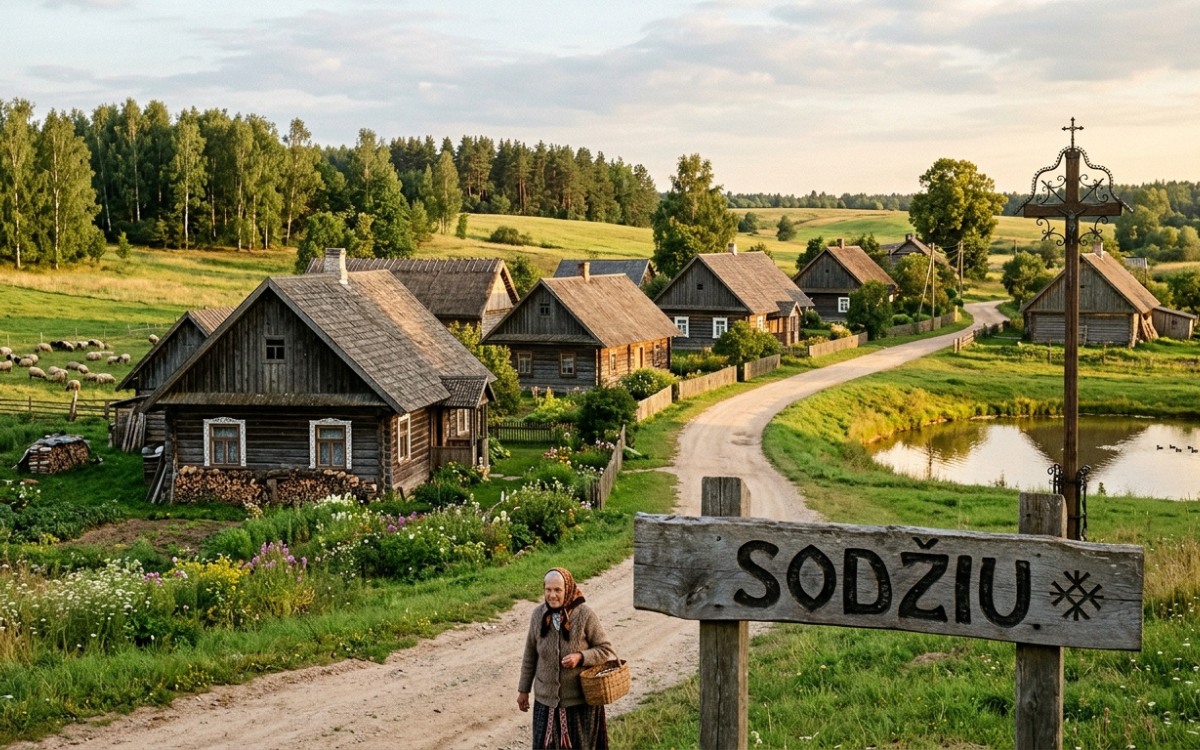
Search for Sodziu and you will find a surprising mix of definitions. Some pages call it a Lithuanian village, others describe it as a conversational expression meaning “basically” or “in short,” and a few attach broad ideas about rural identity, crafts, or lifestyle. The problem is that these explanations often merge different Lithuanian words into one convenient English-language keyword.
The most accurate way to understand the term is to separate spelling, grammar, and cultural context. Sodžius is an established Lithuanian noun referring to a village or rural settlement, while žodžiu is a different word form connected to žodis (“word”) and can mean “orally” or appear in expressions translated as “in a word” or “in short.” Reliable Lithuanian reference sources treat them separately.
That distinction matters. It turns a vague internet keyword into a useful lesson about Lithuanian language, rural history, search-engine transliteration, and how misinformation can spread when diacritics disappear.
What Does Sodziu Actually Mean?
Sodziu is best treated as an ambiguous, non-standardized web spelling rather than a single Lithuanian dictionary headword. In practice, people searching it are usually trying to reach one of two concepts: sodžius, associated with a village or rural settlement, or žodžiu, a separate linguistic form associated with “word,” oral expression, and summarizing speech.
If the intended concept is rural Lithuania, sodžius is the relevant term. The Visuotinė lietuvių enciklopedija describes sodžius as a historical type of Lithuanian rural settlement and notes that the word later became a synonym for kaimas, the ordinary Lithuanian word for village.
If the intended concept is the conversational expression “in short,” the relevant spelling is žodžiu. It is the instrumental singular of žodis (“word”), and Lithuanian dictionaries also record adverbial uses meaning “orally,” “vocally,” or “verbally”; expressions such as vienu žodžiu and žodžiu sakant correspond to “in a word” or “in short.”
This is the first major takeaway: the search term does not have one clean, universally accepted definition. The surrounding context determines which Lithuanian term a writer probably intended.
Why the Spelling Creates So Much Confusion
Lithuanian uses letters that English does not, including ž. When people type without a Lithuanian keyboard, diacritics are often removed, which can blur distinctions for international readers.
Yet simple diacritic removal does not fully explain Sodziu. If you remove the caron from sodžius, you get sodzius, with a final “s.” If you remove Lithuanian diacritics from žodžiu, you get zodziu, beginning with “z,” not “s.”
That means the exact search form is likely to function as a misspelling, truncation, transliteration variant, or SEO keyword rather than a precise standard-language form. This small orthographic detail is important because many competing articles build elaborate cultural claims on top of a spelling they never validate.
Sodziu vs. Sodžius
When Sodziu appears in content about villages, farms, countryside life, traditional settlements, or Lithuanian heritage, the intended word is most plausibly sodžius. The Dictionary of the Lithuanian Language records sodžius for a peasant residential place or village, while the Lithuanian encyclopedia discusses it as a distinct historical settlement type.
Historically, these settlements were not necessarily tidy rows of houses. Encyclopedic descriptions characterize early sodžiai as relatively irregular settlements in which farmsteads could be scattered rather than arranged around a formal street pattern.
Sodziu vs. Žodžiu
The conversational meaning belongs to žodžiu, not sodžius. Grammatically, žodžiu comes from žodis, “word,” and can function in constructions that English speakers render as “in a word,” “briefly,” or “in short.”
This is more than a spelling technicality. Sodžius and žodžiu have different roots, meanings, grammatical behavior, and cultural associations. Treating them as two senses of one magical Lithuanian word may sound appealing, but it sacrifices linguistic accuracy.
The Historical Meaning Behind Sodziu and Sodžius
To understand the rural interpretation of this spelling, it helps to look at how Lithuanian settlement patterns changed over centuries. The Visuotinė lietuvių enciklopedija places the historical sodžius settlement type roughly in the 12th–16th centuries and connects its development with the dispersal of earlier communities into agricultural territories.
These settlements were tied to land use. As households spread toward fields and agricultural production became more organized, small groups of farmsteads developed into recognizable rural communities.
A major change came with the Valakų reform, a 16th-century land and agricultural reorganization in the Grand Duchy of Lithuania. The reform reshaped villages, consolidated dispersed holdings, and encouraged more regular street-village patterns; encyclopedic sources note that many older sodžiai were transformed into organized kaimai.
That history explains why sodžius can feel culturally richer than a bare dictionary translation of “village.” It points toward an older layer of Lithuanian rural settlement, landholding, farming, and community organization.
Sodziu, Kaimas, and Sodyba: Three Terms You Should Not Mix Up
A strong explanation needs to distinguish neighboring concepts. English-language pages often use “village,” “homestead,” “farm,” and “countryside” as if they were interchangeable, but Lithuanian vocabulary is more precise.
Sodžius refers to a village or rural settlement and also has a specific historical settlement sense. Kaimas is the broad, standard term for a village and can also refer to the countryside or rural way of life. The Lithuanian encyclopedia defines kaimas as a historically formed settlement, typically comprising multiple homesteads and traditionally associated with agriculture or, in coastal areas, fishing.
Sodyba, by contrast, refers to a homestead or farmstead: the landholding around a rural resident’s home, including residential and agricultural buildings, yards, gardens, orchards, or related property.
A useful mental model is simple:
- sodžius = village or older rural settlement;
- kaimas = village/countryside in the broader modern sense;
- sodyba = an individual homestead, farmstead, or rural property.
Using these terms correctly immediately improves travel writing, cultural content, translations, genealogy research, and Lithuanian heritage articles.
What Sodziu Reveals About Lithuanian Rural Culture
The cultural value attached to the term should come from documented rural history, not romantic invention. Lithuania’s villages developed through changing systems of agriculture, land tenure, family residence, local administration, and settlement planning. Rural life was therefore both a social system and a physical landscape.
Traditional rural settlements were closely connected to arable fields, livestock, household production, seasonal work, and networks of neighboring families. A village was not merely a cluster of houses; it was an economic and social unit shaped by who used the land, where buildings stood, how roads connected households, and how communities managed shared needs.
That is a more useful cultural reading than claiming the word automatically symbolizes “simplicity,” “spirituality,” or “slow living.” Those associations may be valid in a particular memoir, poem, tourism campaign, or personal interpretation, but they are not part of the core dictionary definition.
Rural Architecture and the Homestead Layer
The physical environment also helps explain why sodžius is often mentally associated with wooden houses, barns, gardens, orchards, and farm buildings. Strictly speaking, many of those features belong more directly to the idea of a sodyba, the individual homestead within a rural landscape.
This distinction creates a richer picture. The village is the settlement; the homestead is the household property inside or around that settlement; the countryside is the larger rural environment connecting them.
For writers, that layered vocabulary is valuable. It prevents the common mistake of turning one foreign word into a catch-all label for every aspect of country life.
Is Sodziu Lithuanian Slang for “Basically” or “In Short”?
Not precisely. The Lithuanian expression that carries that function is žodžiu.
Because žodžiu derives from žodis (“word”), its summarizing role makes intuitive sense: phrases built around it can mean “in a word,” “briefly,” or “to put it shortly.” Dictionaries and language-learning references support this connection directly.
In informal speech, discourse markers can acquire tone beyond their literal grammar. Depending on placement and delivery, English translations might include “so,” “basically,” “anyway,” or “in short.” But translation should remain contextual rather than pretending every instance maps to one fixed English filler word.
This is where many articles on the topic go wrong: they notice real information about žodžiu, notice separate information about sodžius, then combine the two into a supposed “dual meaning.” A better approach is to tell readers that they are encountering two different Lithuanian forms that have been collapsed by web spelling and secondary content.
Common Myths and Misleading Claims About Sodziu
Search results around the term contain more speculation than the topic deserves. When evaluating a claim, ask a basic question: can it be traced to a Lithuanian dictionary, encyclopedia, linguistic reference, museum, archive, university, or other specialist source?
Be skeptical of claims that the term is the official name of a traditional dyeing method, a specific craft movement, a hidden Lithuanian destination, or a centuries-old philosophy of minimalist living unless a credible source documents that usage. The existence of rural textiles, folk crafts, natural dyes, or heritage tourism in Lithuania does not automatically make this word their formal label.
The same caution applies to branding narratives. A company or creator can certainly adopt the spelling as a name and assign it a personal meaning, but that modern brand story should not be presented as historical Lithuanian etymology.
For researchers and content creators, a practical verification workflow is:
- Identify the exact Lithuanian spelling, including diacritics.
- Check the dictionary headword and grammatical form.
- Separate lexical meaning from metaphorical or brand usage.
- Confirm historical claims with Lithuanian reference works.
- Treat uncited lifestyle symbolism as interpretation, not fact.
That five-step process is simple, but it eliminates most of the errors currently repeated across low-authority pages.
How to Use Sodziu Correctly in Content
If you are writing for an English-speaking audience, the safest approach is to introduce the search spelling, then immediately provide the correct Lithuanian term relevant to your context.
For rural history, write something like: Sodziu is commonly encountered online in discussions of Lithuanian sodžius, an older word for a village or rural settlement. After that clarification, use sodžius when discussing the Lithuanian noun itself.
For language-learning content about “in short” or “basically,” use žodžiu. Do not silently replace it with the rural word, and do not claim that village life is the hidden emotional origin of the conversational expression without evidence.
This practice supports E-E-A-T in a very concrete way. It demonstrates subject-matter care, identifies ambiguity before giving advice, distinguishes primary linguistic evidence from secondary interpretation, and helps readers avoid repeating a false equivalence.
Why Sodziu Is an Interesting SEO Case Study
From an SEO perspective, this query shows what happens when search demand forms around an unstable spelling. Once several pages publish competing definitions, search engines must infer intent from co-occurring entities such as Lithuania, village, countryside, language, meaning, sodžius, žodžiu, kaimas, and sodyba.
That creates an opportunity for better content. Instead of choosing one popular definition and padding it to 1,500 words, a high-quality page can resolve the ambiguity, explain the linguistic mechanics, document the historical settlement meaning, and warn readers about unsupported claims.
It also creates natural semantic coverage for long-tail queries such as Sodziu meaning, Lithuanian village meaning, sodžius definition, žodžiu meaning, Lithuanian word for village, Lithuanian word for “in short,” kaimas vs sodyba, and traditional Lithuanian rural settlements.
The ranking advantage comes from information gain, not repetition. A page that tells readers why the SERP is confused is more useful than another page that simply joins the confusion.
FAQ About Sodziu
What is the English meaning of Sodziu?
There is no single exact English translation because the search spelling is ambiguous. In rural-history contexts, it usually points toward sodžius, meaning a village or rural settlement. In conversational-language contexts, writers may actually mean žodžiu, a different Lithuanian form used in expressions meaning “in a word,” “in short,” or “orally.”
Is Sodziu a real Lithuanian word?
The exact undiacritized form is not the clearest standard dictionary headword for either major meaning circulating online. Sodžius is a documented Lithuanian noun for a village/rural settlement, while žodžiu is a documented form of žodis. Treat the web spelling as an ambiguous search variant and verify the intended Lithuanian form from context.
Does Sodziu mean “village” or “basically”?
Those meanings come from different Lithuanian words. Sodžius is associated with “village” or “rural settlement.” Žodžiu is the form connected with “word” and can appear as a discourse marker translated contextually as “in short,” “basically,” or “so.” Combining them as two formal meanings of one word is misleading.
What is the difference between sodžius and sodyba?
Sodžius refers to a village or rural settlement, historically including a particular Lithuanian settlement type. Sodyba refers to an individual homestead or farmstead with its residential and agricultural buildings, yards, gardens, and related land. One describes the settlement; the other describes the household property.
Why do so many websites give different definitions of Sodziu?
The biggest reason is spelling collapse. Lithuanian diacritics are often removed online, and secondary sites have mixed information about sodžius with separate information about žodžiu. Once that blended explanation is copied and paraphrased, it can look established even when authoritative references keep the terms distinct.
Conclusion: Use the Right Lithuanian Word, Not Just the Popular Search Spelling
Sodziu is useful precisely because it exposes a problem readers rarely see: search popularity does not guarantee linguistic accuracy. The strongest evidence points to two separate concepts—sodžius, the village or historical rural-settlement term, and žodžiu, the language form connected to “word” and expressions such as “in short.”
If you are publishing content, translating Lithuanian material, researching family history, or writing about Baltic culture, verify the diacritics first. Then match the word to its real grammatical and historical context, cite Lithuanian reference sources, and label broader cultural interpretations as interpretations.
Do that, and your page will offer something far more valuable than another recycled definition: clarity readers can trust.