
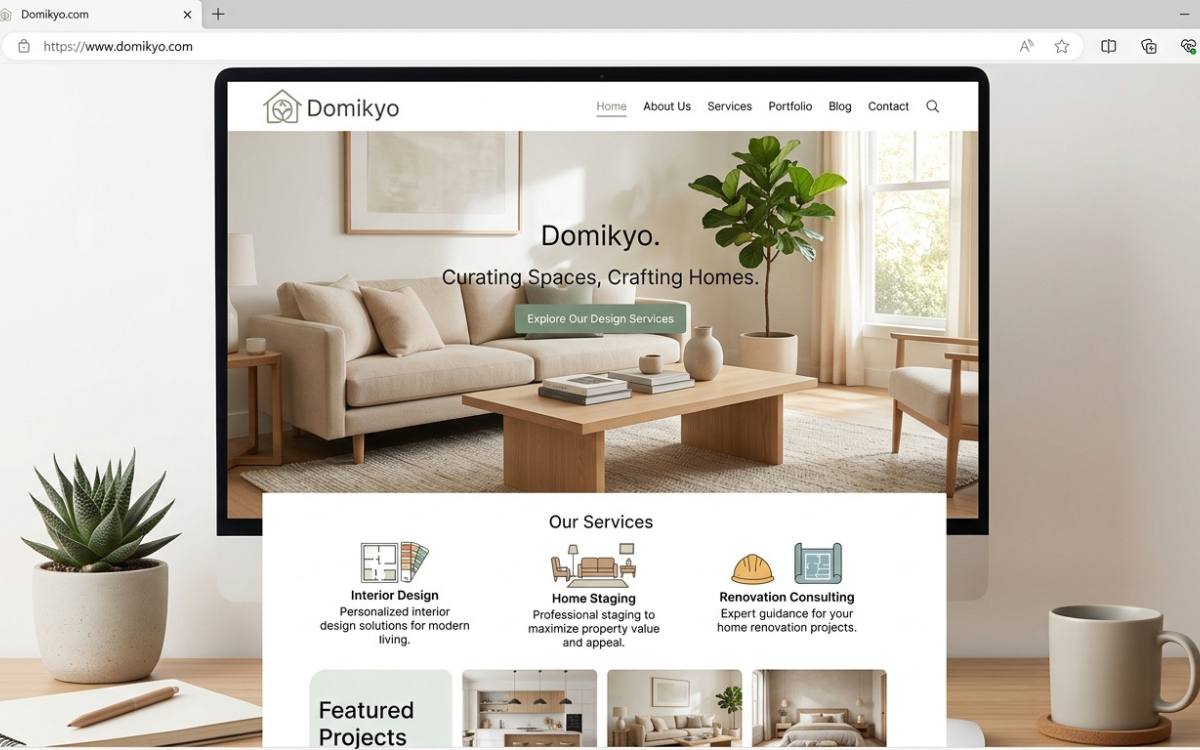
Domikyo.com is attracting search interest, but there is an unusual problem: the pages ranking for the name do not agree on what the website actually does. Some describe it as a smart-home, IoT, networking, and digital-lifestyle resource, while another presents it as a provider of web development, digital marketing, content creation, project tools, and paid service tiers.
That gap matters. A useful guide should separate what is observable from what is merely repeated elsewhere, especially when searchers may be deciding whether to trust information, submit personal details, or purchase a service.
As of August 19, 2026, the clearest public picture is that Domikyo.com is an emerging web property surrounded by a growing cluster of third-party articles. However, those articles are not consistent enough to treat every claimed feature, service, testimonial, or pricing detail as established fact.
During research for this guide, a direct automated request to the domain returned a 403 Forbidden response. That can happen because of bot protection or access-control rules, so the response alone does not establish that a website is unavailable to normal visitors, fraudulent, or unsafe.
This guide therefore takes a verification-first approach. You will learn what the current search landscape says, where those claims conflict, how to judge the website’s trustworthiness, and what to check before relying on its content or paying for anything.
What Is Domikyo.com?
The safest description is that Domikyo.com is a website whose identity is still inconsistently documented across third-party search results. Several recent publishers connect it with smart-home technology, Internet of Things devices, digital connectivity, networking, automation, security, and lifestyle content.
Hardware Secrets, for example, characterizes the platform as a resource combining smart-home technology and networking, with coverage touching IoT integration, privacy, Matter, Thread, routers, network performance, and home automation. Beziddi offers a similar description centered on connected devices, home security, energy management, voice assistants, and IoT technology.
Yet that is not the only story.
Business News Network describes the same domain as a business-services platform offering website development, SEO, social media management, content creation, customer support, customization, and different pricing levels. Its article also discusses alleged customer experiences and service-delivery performance, although the page does not show primary documentation from the site’s operator substantiating those claims.
That contradiction is the most important thing a new reader should understand about Domikyo.com. Instead of assuming every ranking page describes the same verified product, treat the current SERP as a collection of competing descriptions that should be checked against first-party evidence.
Why Search Results About Domikyo.com Are Confusing
Search engines can rank pages discussing a brand even when those pages are not controlled by the brand itself. The complication arises when multiple third-party pages make overlapping claims and repetition begins to look like independent verification.
For Domikyo.com, current coverage broadly follows three narratives. One describes a smart-home and networking knowledge resource, another portrays a broader technology and lifestyle publication, and another presents the domain as a company selling digital services.
Those models could theoretically coexist. A technology publisher could offer commercial services, and a general-interest publication could maintain a strong smart-home category, but the sources currently ranking for the name do not provide enough first-party evidence to prove that all three descriptions represent the site’s actual operating model.
This is where an E-E-A-T-oriented evaluation becomes valuable. Rather than judging credibility from polished prose alone, examine who is making each claim, what evidence supports it, whether the author has relevant expertise, and whether the information can be traced back to an official or primary source.
What Current Sources Claim Domikyo.com Covers
The smart-home interpretation is the strongest recurring theme in current search results. Hardware Secrets associates the domain with connected-home networking, IoT security, interoperability, Matter, Thread, router setup, firmware maintenance, and home automation.
Beziddi similarly associates Domikyo.com with smart-home systems, IoT technologies, connected security, smart energy management, voice-assistant integration, and emerging technology trends. Its framing is primarily educational rather than commercial.
Vents Magazine presents a broader version of that concept. Its article describes the site as covering technology and digital connectivity while also extending into subjects such as business, finance, lifestyle, health, wellness, and guest contributions.
That description suggests a possible general-interest publication with a technology emphasis, rather than a narrowly specialized smart-home product or service.
These third-party claims are useful for understanding how the brand is being positioned online. They should not, however, be confused with verified first-party documentation from the owner or operator.
Domikyo.com Verification Matrix: What Looks Consistent?
The simplest way to cut through conflicting articles is to separate repeated associations from claims that appear only once or lack visible primary evidence.
| Claim | Current evidence | Confidence |
|---|---|---|
| The domain is being discussed as an emerging online platform | Multiple recent third-party articles discuss it | Moderate |
| Smart-home, IoT, networking, and connected-living topics are associated with it | Repeated by Hardware Secrets, Vents Magazine, and Beziddi | Moderate |
| The site provides web development, SEO, social media, and content services | Claimed prominently by Business News Network | Low until independently confirmed |
| It offers free features plus paid pricing tiers | Claimed by one third-party review | Low |
| It has established customer testimonials and documented support performance | Claimed by one third-party review without visible primary substantiation | Low |
| It accepts guest posts | Claimed by Vents Magazine | Low to moderate until official guidelines are verified |
| The reviewed material proves the website is fraudulent or dangerous | The sources reviewed do not provide such proof | Not established |
The distinction is important. A lack of evidence is not evidence of wrongdoing, but a polished article on another website is also not proof that a product, customer testimonial, service package, or pricing plan exists.
Is Domikyo.com Legit and Safe to Use?
There is not enough verified information in the material reviewed here to support a responsible one-word “safe” or “scam” verdict. The more useful question is what level of verification is appropriate for the action you intend to take.
If you are simply reading publicly accessible articles, the decision is different from creating an account, uploading documents, installing software, or submitting payment information. Google Chrome’s Safe Browsing protections are designed to warn users about websites associated with phishing, malware, unwanted software, and social-engineering threats.
A secure HTTPS connection is also worth checking, but it should not be treated as a complete reputation test. Chrome explains that HTTPS authenticates and encrypts the connection between the browser and website; broader safety warnings are handled through additional protections such as Safe Browsing.
If Domikyo.com asks for payment or sensitive information, the verification threshold should rise substantially. The U.S. Federal Trade Commission advises consumers dealing with unfamiliar sellers to research the company name alongside terms such as “review,” “complaint,” or “scam” and to investigate important purchasing and refund conditions before buying.
A Practical Domikyo.com Trust Checklist
- Confirm the official identity. Look for an About page naming the publisher, business entity, owner, or responsible editorial team.
- Check contact routes. A working domain-based email address, support channel, and clear business contact information provide more accountability than an anonymous form alone.
- Inspect legal documentation. Review privacy terms, website terms, refund policies, cookie disclosures, and commercial conditions before sharing data or money.
- Verify authorship. For technical, health, financial, or security-related information, prefer named writers with relevant expertise and visible source attribution.
- Cross-check consequential claims. Compare product specifications, protocols, financial claims, or security advice with manufacturers, regulators, standards bodies, or other primary sources.
- Watch for unusual payment demands or pressure. The FTC warns consumers to be cautious when sellers demand payment through methods commonly associated with scams or create pressure to act immediately.
- Keep browser protections enabled. Do not bypass a browser security warning simply because another website published a positive review.
How to Verify Domain Information
One useful step is checking the underlying domain-registration record instead of relying only on review blogs.
Since January 28, 2025, ICANN has treated the Registration Data Access Protocol (RDAP) as the definitive source for generic top-level domain registration information, replacing the previous WHOIS-based approach for gTLD registration data.
An RDAP lookup can help a researcher inspect information such as the registrar, domain status, registration events, and whatever registrant information is publicly disclosed. ICANN notes that RDAP is specifically designed to provide access to domain-name registration data.
Privacy-protected or redacted ownership details should not automatically be treated as suspicious. Domain privacy is common, so registration data is one signal among many—not a substitute for examining the website’s content, business identity, policies, reputation, and behavior.
How to Judge the Quality of Domikyo.com Content
If the website is primarily an informational publisher, its quality is best judged article by article, not solely from third-party reputation pieces.
Start with evidence density. Does an article cite original documentation, technical standards, manufacturer specifications, government guidance, research papers, or direct interviews, or does it provide precise numbers and conclusions without showing where they came from?
Next, examine update discipline. Subjects commonly associated with Domikyo.com—smart-home platforms, router firmware, cybersecurity recommendations, device compatibility, software, and connected-home protocols—can change, so useful articles should clearly distinguish evergreen explanations from time-sensitive instructions.
Authorship matters too. A detailed smart-home networking article written by someone with demonstrable networking experience should carry more weight than anonymous content that merely repeats product features from marketing copy.
Good technology content should also explain trade-offs.
Connected devices can offer convenience, but genuinely useful guidance considers privacy, local versus cloud processing, software-support periods, interoperability, vendor lock-in, network reliability, update policies, and failure modes. Depth becomes especially important when an article influences a purchasing or security decision.
If Domikyo.com Is a Smart-Home and IoT Resource
The repeated association with connected homes gives readers a practical way to evaluate the site’s expertise.
A credible smart-home publication should go beyond roundups of attractive gadgets. It should explain the infrastructure behind those devices: Wi-Fi coverage, Ethernet backhaul, mesh networking, wireless congestion, device isolation, firmware management, local control, cloud dependencies, and interoperability.
Coverage of standards should also be precise. Hardware Secrets specifically associates Domikyo.com with subjects including Matter and Thread, while its article also discusses Zigbee, Z-Wave, networking segmentation, routers, and local smart-home communication.
For readers, the useful questions are practical.
Will a smart lock continue working if the internet connection drops? Does a camera require a cloud subscription? Can data remain local? Does a thermostat integrate with the existing ecosystem? How long will the manufacturer provide firmware and security updates?
Those are the details that separate useful smart-home guidance from generic technology commentary.
Privacy and Security Should Be More Than Buzzwords
Connected-home advice becomes sensitive because smart cameras, microphones, locks, occupancy sensors, and other devices can collect information about real-world activity.
That means privacy recommendations need specificity. An article should explain what information a device collects, where it is processed, whether local processing is available, whether data is stored in the cloud, what permissions an app requests, and how users can secure their account.
Basic cybersecurity practices matter as well. CISA recommends multifactor authentication as an additional layer of account protection and notes that phishing-resistant MFA methods offer stronger protection than weaker alternatives.
If Domikyo.com builds substantial smart-home coverage, explaining these trade-offs clearly would create far more reader value than simply labeling a product “secure.”
If Domikyo.com Offers Digital Services, Verify the Commercial Layer Separately
One ranking review makes a substantially different claim: that the domain provides web development, digital marketing, search-engine optimization, social media management, content creation, customization, and customer support. It also refers to different pricing levels and user testimonials.
Because other prominent articles describe the property as a smart-home or editorial platform instead, prospective customers should verify those commercial offerings directly before making a purchasing decision.
If services are genuinely available, ask for a written scope of work. It should define deliverables, deadlines, revision limits, cancellation conditions, intellectual-property rights, payment milestones, and exactly what happens after the engagement ends.
For SEO work, avoid vague promises such as “guaranteed rankings.” Ask what activities will actually be performed, how progress will be measured, what reporting is supplied, and whether link acquisition and content practices comply with current search-engine policies.
For web development, confirm who owns the domain, hosting account, analytics property, website files, source code, design assets, and administrator credentials after completion. Those details are much more meaningful than generic statements about increasing growth or online visibility.
What Makes a Strong Technology Publication?
Readers should expect more than keyword coverage.
Strong editorial content demonstrates experience through examples, expertise through accurate explanation, authority through sourcing, and trust through transparency. When a writer tests a router, automation platform, smart lock, or connected device, the article should ideally explain the test environment and limitations.
Original screenshots, measurements, compatibility tests, before-and-after results, documented troubleshooting, and clearly identified product versions provide information that cannot be generated by simply summarizing other websites.
That is where Domikyo.com could create genuine information gain if its long-term direction is technology publishing. Original evidence is harder to produce than generic copy, but it is also far more useful to users.
Who Is Domikyo.com Most Useful For?
At this stage, the site appears most relevant to readers who encounter the name in search and want to understand its possible technology, smart-home, IoT, or digital-lifestyle focus. Those are the strongest recurring themes across multiple independent pages currently discussing the brand.
Smart-home beginners may find value if the live site provides practical guides, while more technical readers should expect deeper sourcing and reproducible instructions. Business owners, meanwhile, should verify agency-style service claims before assuming that services described by third parties are officially available.
The same caution applies to pricing, subscriptions, testimonials, guarantees, and support-response claims. Those details should ideally come from current official documentation rather than a secondary article.
That does not make Domikyo.com untrustworthy. It means its third-party search footprint currently communicates more certainty than the available first-party evidence supports.
How Domikyo.com Can Build Stronger Trust
For an emerging website, the fastest route to credibility is not louder promotion. It is verifiability.
Clear ownership information, detailed author profiles, transparent editorial standards, correction policies, publication dates, visible update histories, primary-source citations, and consistent category architecture would make the site’s identity easier for both readers and search engines to understand.
If product reviews are part of the editorial model, a published testing methodology would add significant credibility. Readers should be able to see whether products were physically tested, researched from manufacturer documentation, compared with alternatives, or evaluated through some other process.
If commercial services are part of the business model, trust would benefit from transparent service descriptions, clear contracting terms, genuine case studies, identifiable client outcomes where permission exists, and unambiguous contact information.
A strong About page could resolve perhaps the biggest current search-result problem around Domikyo.com in one place: Is it a publication, a connected-home specialist, a digital agency, or a hybrid of those models?
Searchers should not have to read five conflicting third-party articles to answer that basic question.
Frequently Asked Questions About Domikyo.com
1. What is Domikyo.com used for?
Current third-party coverage most commonly associates Domikyo.com with smart-home technology, IoT, networking, automation, and digital-lifestyle information. Hardware Secrets, Beziddi, and Vents Magazine all provide variations of that description, although another ranking publication presents it as a digital-services business.
Because those descriptions conflict, the site’s live first-party pages should be treated as the final authority on its current purpose.
2. Is Domikyo.com a smart-home website?
Several current sources describe it that way. Their coverage connects the name with connected homes, IoT, home networking, Matter, Thread, security, automation, energy management, and voice-assistant technology.
That makes smart-home technology the strongest recurring association in the present search landscape. It is still sensible to verify the website’s current navigation, categories, and editorial focus directly.
3. Is Domikyo.com legitimate?
The material reviewed for this article does not provide enough authoritative evidence for a responsible one-word verdict. Conflicting third-party descriptions make direct verification more important, not less.
Before entering sensitive information or making a payment, inspect the site’s identity, legal pages, contact details, browser security warnings, payment conditions, refund terms, and independent reputation. The FTC specifically recommends researching unfamiliar businesses before purchasing.
4. Does Domikyo.com offer SEO, web development, or marketing services?
One third-party review claims that Domikyo.com offers website development, SEO, social media management, and content creation, along with customization and different pricing options.
Other prominent sources instead describe a technology and smart-home content platform. Because those accounts do not match, verify any service offering, price, contract, portfolio, or support promise directly through official channels before buying.
5. How should I use information from Domikyo.com?
Use useful articles as a starting point, then verify consequential claims with primary sources.
For smart-home advice, that means checking manufacturers, standards documentation, firmware-release notes, compatibility databases, and authoritative cybersecurity guidance. For purchases or paid services, verify the seller’s identity, contractual terms, refund rules, payment protections, and deliverables before committing money.
The Bottom Line
Domikyo.com has enough recent search visibility to generate genuine curiosity, but its online identity is still being shaped by third-party pages that do not fully agree with one another. Some portray it as a connected-home technology resource, others broaden that description into technology and lifestyle publishing, while another presents it as a digital-services business.
The right response is neither automatic trust nor automatic suspicion. Verify.
Visit the official site, identify who runs it, inspect current categories and legal documentation, check authors and sources, and independently confirm any commercial claim before paying. If the platform demonstrates consistent expertise, transparent ownership, strong sourcing, and useful original material, bookmark the sections that genuinely solve your problems; if evidence remains thin, use its content for discovery and verify important decisions with authoritative primary sources.